
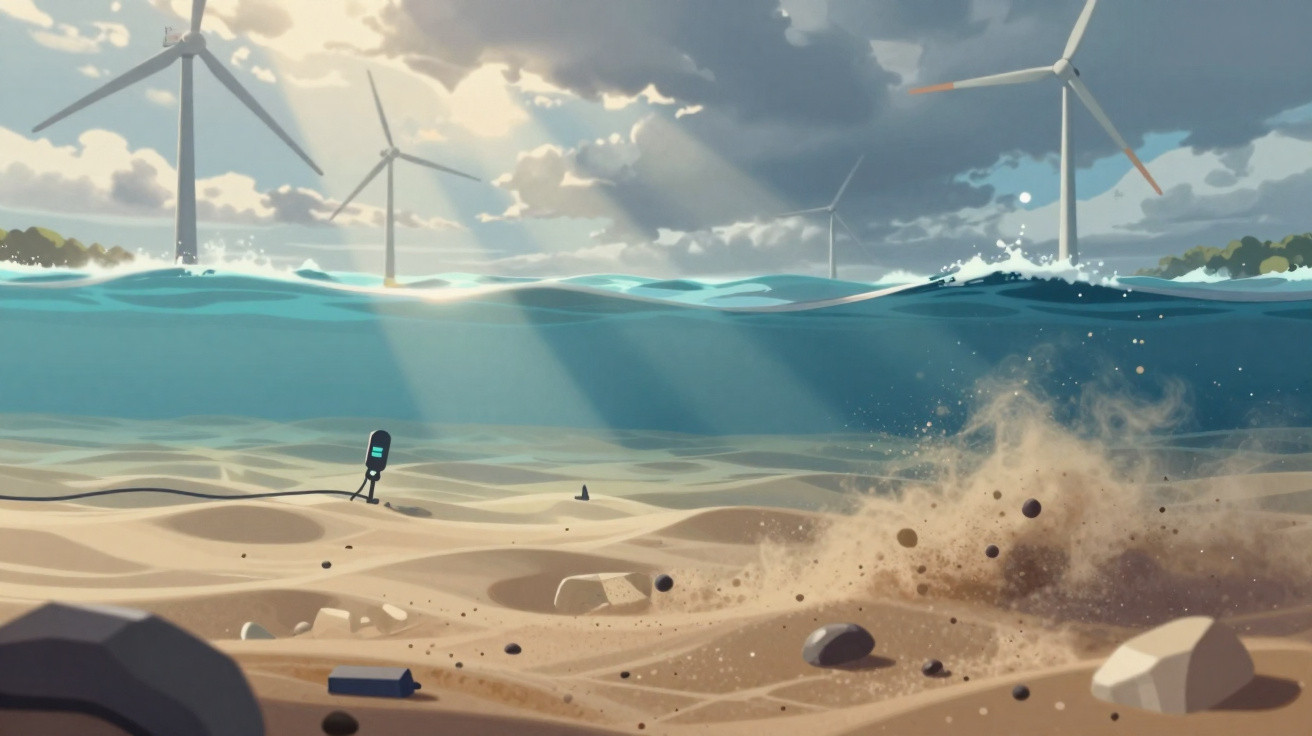
A hidden frontier
A lógica parece simples: com mais água sobre o fundo, a pressão e a tensão no leito marinho deveriam aumentar. Só que, quando você entra nos detalhes da física de ondas e marés, o resultado não é tão direto assim.
Um estudo recente resolveu olhar para o que acontece “lá embaixo”. O que ele encontrou na plataforma do noroeste da Europa afeta tudo o que descansa nesse piso - de turbinas e cabos a animais que vivem enterrados ou apoiados no sedimento.
Most climate research targets warming surface waters or shrinking coastlines. Yet the composition of the seabed – and the creatures living in or on it – rarely make the cut.
Dr. Julia Rulent, an oceanographer at the National Oceanography Centre (NOC), led a team that set out to change that.
The researchers combined ocean and wave simulations with climate projections stretching to 2093.
The case study area was the North Western European Shelf, but the underlying physics applies to shelf seas worldwide. Specifically, the team asked what rising seas and bigger storms will do to the stress on the ocean floor.
Two competing forces
The study separates two main drivers. Sea level rise raises the surface farther from the seabed, reducing how strongly waves and tidal currents “grab” the bottom.
With that, the seabed tends to quiet down, becoming more stable and easier to predict. Storms, on the other hand, push in the opposite direction.
A warming atmosphere is expected to bring fewer winter storms over northwest Europe, but with greater intensity. Each one delivers short, sharp bursts of energy that reach the seabed.
Before this work, no one had put numbers on how these two forces add up - when they matter, where they dominate, and how strongly the seafloor feels them across an entire shelf sea.
Sea level’s quiet effect
Using UK climate projections, the team tested sea level rise in two steps - about 28 centimeters by mid-century and 71 centimeters by 2100 - and then ran the same weather through both setups.
Deeper water mutes almost everything. Near the bottom, tidal currents weaken, and wave energy has a harder time reaching the seabed.
The amphidromes - still points where tidal range drops to zero - shift by as much as 3.9 kilometers.
Across the shelf, the mean drop in seabed stress is modest but consistent - strongest in shallow areas and in high-tide estuaries such as Morecambe Bay.
There is, however, a catch. Where waves no longer dissipate over Dogger Bank, more energy can survive to the coast, and the German Bight may experience larger nearshore waves.
Seabed stress from storms
Storm dynamics point the other way. Warmer seas are associated with stronger low-pressure systems.
Recent projections indicate UK storm severity could increase by 30% by 2080, largely because storms cover bigger areas.
In Rulent’s simulations, an intense late-century winter storm can add up to 15 newtons per square meter of stress at the seabed.
That is more than double the force of today’s strongest spring tides. In some places, storm-driven stress can jump by an entire order of magnitude - ten times the calm-state conditions.
Bigger grains start moving
What currents can move depends on how hard they push. Under today’s calm summer conditions, only very fine sands smaller than 0.1 millimeters are lifted.
Major storms can mobilize grains larger than 11 millimeters, like small pebbles. And on Atlantic-facing coasts, peak storm conditions can already roll stones above 25 millimeters - roughly the size of a coin.
Today, the seasonal transition from summer to winter changes the type of sediment the ocean can transport across more than 500,000 square kilometers of the shelf.
By the end of the century, future winters are projected to push that threshold beyond 640,000 square kilometers.
Widening seasonal gap
Together, these effects create an unusual new cadence. Summers are expected to become calmer as wave conditions soften and sea level rise adds depth.
Winters, meanwhile, are likely to hit harder as stronger storms arrive. Benthic habitats - the worms, clams, crabs, and other organisms that depend on a stable seafloor - evolved under the current seasonal pattern.
“Increased storminess may create more and bigger disturbance regimes for benthic communities,” Rulent and her colleagues wrote.
As a consequence, species that rely on quiet periods to recolonize disturbed patches of seabed may see those recovery windows shrink.
Offshore wind at risk
The shelf is among the busiest industrial seascapes in the world. Offshore wind capacity in the EU and UK was 36 gigawatts in 2023, with 110 gigawatts planned by 2030.
Turbines, steel foundations, scour-protection rocks, and seabed cables all rest on a floor whose dynamics are shifting. That means rock armor sized for today’s currents may not be enough for the storms of 2080.
A related study, led by some of the same researchers, found that a single turbine foundation can more than double the force a current exerts on the seabed in its wake. Climate-driven changes could then stack on top of that.
What comes next
For the first time, future shifts in seabed stress and sediment mobility have been mapped across a full shelf sea. The seasonal contrast between summer and winter is expected to widen through the century.
Sea level rise will soothe the seabed - gradually and in a fairly predictable way. Storms will disrupt it more intensely and more often, leaving the overall outcome tied to an expanding seasonal gap.
These changes ripple into offshore wind engineering, marine protected area planning, and fisheries management. And the same physics holds for shelf seas around the globe.






Comentários
Ainda não há comentários. Seja o primeiro!
Deixar um comentário