
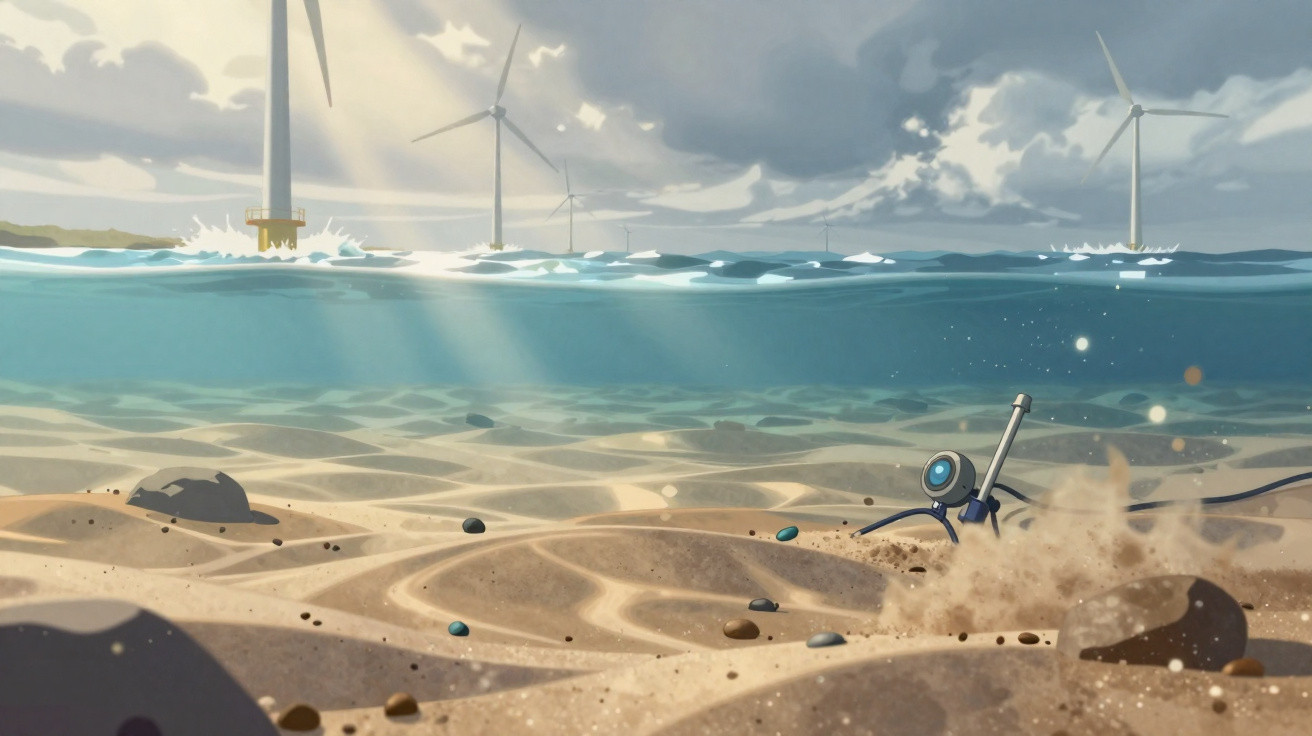
A hidden frontier
A intuição diz que, com mais água em cima do fundo do mar, a pressão e o “estresse” no leito deveriam aumentar. Mas, quando você coloca a física das ondas e das marés na conta, o resultado não é tão direto assim - e a elevação do nível do mar pode, em certos aspectos, até acalmar o fundo.
Um estudo recente resolveu olhar para essa história abaixo da linha d’água. O que ele encontrou na plataforma do noroeste europeu ajuda a entender o futuro de turbinas eólicas offshore, cabos submarinos e também dos organismos que vivem apoiados (ou enterrados) nesse sedimento.
Most climate research targets warming surface waters or shrinking coastlines. Yet the composition of the seabed – and the creatures living in or on it – rarely make the cut.
Dr. Julia Rulent, an oceanographer at the National Oceanography Centre (NOC), led a team that set out to change that.
The researchers combined ocean and wave simulations with climate projections stretching to 2093.
The case study area was the North Western European Shelf, but the underlying physics applies to shelf seas worldwide. Specifically, the team asked what rising seas and bigger storms will do to the stress on the ocean floor.
Two competing forces
The work isolates two drivers. Sea level rise lifts the surface farther from the bed, weakening the grip of waves and tidal currents on the bottom.
As a result, the seabed grows calmer, becoming more predictable and steady. In contrast, storms do the opposite.
A warming atmosphere is expected to push fewer but more powerful winter storms across northwest Europe. Each one hammers short pulses of energy down to the bottom.
Until this study, no one had quantified how the two forces combine – when, where, and how hard the seafloor would feel them across an entire shelf sea.
Sea level’s quiet effect
Drawing from UK climate projections, the team added rising water in two amounts – about 11 inches (28 centimeters) by mid-century and 28 inches (71 centimeters) by 2100. They then ran identical weather through both versions.
Deeper water dampens nearly everything. As a result, tidal currents along the bottom slow, and wave energy struggles to reach the seabed.
The amphidromes – still points where tidal range falls to zero – drift by up to 2.4 miles (3.9 kilometers).
Across the shelf, the average reduction in seabed stress is small but consistent – biggest in shallow water and high-tide estuaries like Morecambe Bay.
However, there is a twist. Where waves no longer dissipate over Dogger Bank, more wave energy survives to the coastline, and the German Bight could see bigger waves near shore.
Seabed stress from storms
Storm behavior tells a different story. Warmer seas are linked to stronger low-pressure systems.
Recent projections suggest UK storm severity could rise by 30% by 2080, mostly from storms covering larger areas.
In Rulent’s simulations, a severe end-century winter storm can add up to 15 newtons per square meter of stress at the seabed.
In fact, that is more than twice the force of today’s strongest spring tides. Storm stress in some regions can climb by an entire order of magnitude – ten times calm conditions.
Bigger grains start moving
What the current can pick up depends on how hard it pushes. Calm summer conditions today lift only fine sands smaller than 0.004 inches (0.1 millimeters).
Big storms can dislodge grains over 0.4 inches (11 millimeters), such as small pebbles. Moreover, on Atlantic-facing coasts, peak storm conditions can already roll stones above 1 inch (25 millimeters) – roughly the size of a quarter.
Today, the seasonal shift from summer to winter changes the type of sediment the ocean can move across more than 193,000 square miles (500,000 square kilometers) of shelf.
By century’s end, future winters will push that threshold past 247,000 square miles (640,000 square kilometers).
Widening seasonal gap
The combination produces a strange new rhythm. Summers are projected to grow quieter as wave conditions soften and rising seas add depth.
Meanwhile, winters are expected to get fiercer as harder storms hit. Benthic habitats – the worms, clams, crabs, and other creatures depending on a stable floor – evolved with the present pattern.
“Increased storminess may create more and bigger disturbance regimes for benthic communities,” Rulent and her colleagues wrote.
As a result, species that depend on calm intervals to recolonize disturbed patches of seabed may find those windows shrinking.
Offshore wind at risk
The shelf is one of the busiest industrial seascapes on Earth. Offshore wind capacity in the EU and UK stood at 36 gigawatts in 2023, with 110 gigawatts planned by 2030.
Turbines, steel foundations, scour-protection rocks, and seabed cables all sit on a floor whose behavior is changing. Consequently, rock armor sized for today’s currents may not hold for the storms of 2080.
A related study led by some of the same researchers showed that a single turbine foundation can more than double the force the current exerts on the seabed in its wake. In turn, climate-driven forces could pile on top of that.
What comes next
For the first time, future changes to seabed stress and sediment mobility have been mapped across an entire shelf sea. The seasonal gap between summer and winter is projected to widen through the century.
Sea level rise will calm the bed – gently and predictably. In contrast, storms will disturb it harder and more often, and the net effect lies in a widening seasonal gap.
All of this reaches into offshore wind engineering, marine protected area planning, and fisheries management. The same physics applies to shelf seas worldwide.






Comentários
Ainda não há comentários. Seja o primeiro!
Deixar um comentário