
Gathering at the reef
A reprodução do tubarão-touro costuma ser descrita como algo rápido e impessoal. Dois animais se encontram no mar aberto, acasalam e seguem caminhos separados, sem motivo para se verem de novo. Em tese, basta ter “alguém por perto”.
Mas, nas águas de Fiji, esse roteiro parece simples demais. Ali, algumas fêmeas dão sinais de voltar ano após ano às mesmas áreas para parir. E, quando os pesquisadores olharam para a genética, apareceu uma pista ainda mais intrigante sobre os parceiros que elas acabam reencontrando.
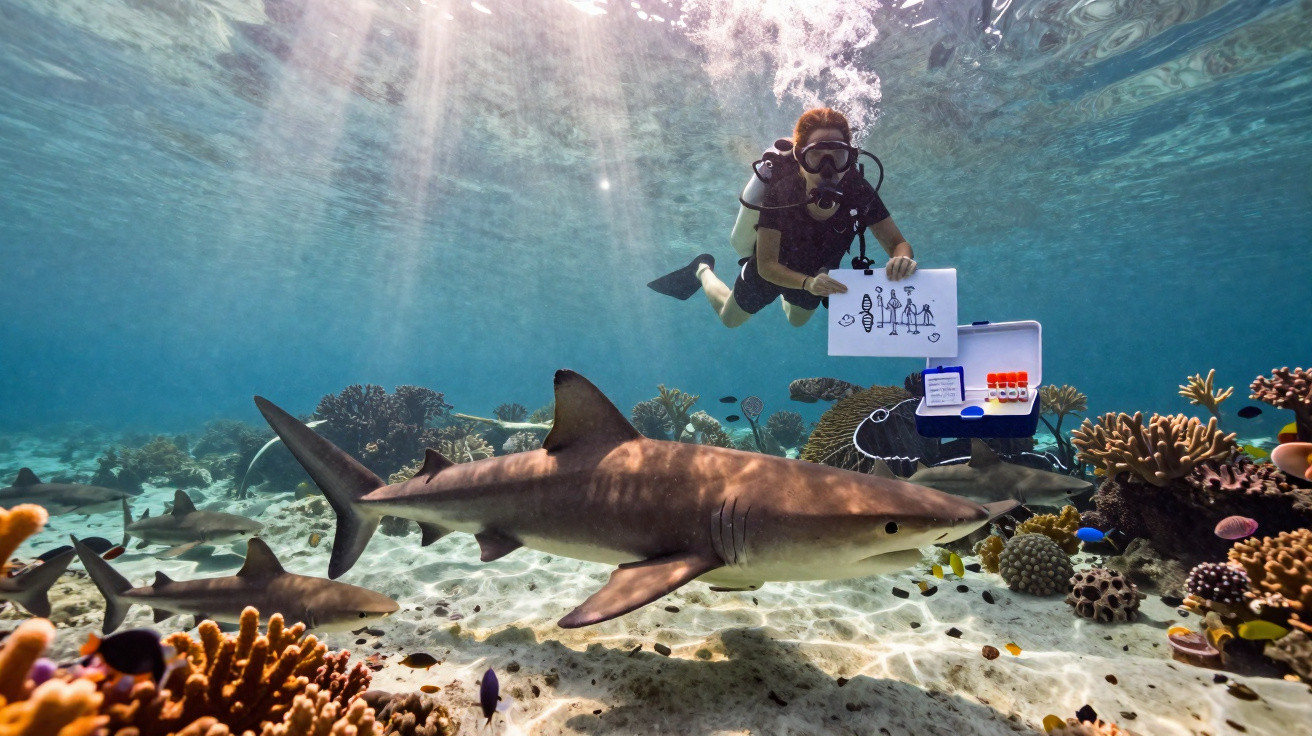
Off Viti Levu, Fiji’s largest island, adult bull sharks (Carcharhinus leucas) crowd into a protected zone called the Shark Reef Marine Reserve. Fishing is banned there, and divers come to watch them feed.
Near each year’s end, the pregnant females leave for nearby rivers to give birth. Their pups grow up in murky water, part fresh and part salt, before heading out to sea.
Researchers long suspected the reef adults and river pups were one population, but the family links stayed hidden. Pinning that down fell to marine biologist Kerstin Glaus and colleagues at the University of the South Pacific (USP).
Building the family tree
Over more than a decade, the team gathered tissue – muscle from reef adults between 2007 and 2017, and fin clips from young sharks netted in the rivers. In all, 353 animals.
They read thousands of tiny markers in each shark’s DNA and ran them through software that reconstructs family trees, flagging siblings and parent-offspring pairs.
After repeat captures were removed, 296 individuals remained. The result was a web of relatives.
The analysis found 375 related pairs, 146 of them full siblings and the rest half siblings, scattered across the reef and the rivers.
Reef adults, river pups
Earlier tracking had shown pregnant females entering the river estuaries, so a connection was already suspected. The DNA turned that suspicion into something solid.
Reef adults proved close kin to newborns and juveniles in the Navua and Rewa rivers. One adult sampled at the reef in 2011 was a full sibling of four young sharks later pulled from the Navua.
They shared parents but were born in different seasons. Different years, same bloodline.
Taken together, the links show how much these rivers matter. Much of the population is born and raised in them, knitting Fiji’s coastal sea and freshwater into one connected system.
Mothers that return
Within a single river, some related youngsters were caught more than two years apart, matching the species’ two-year breeding cycle.
That timing is a hallmark of reproductive philopatry – returning to the same place to give birth, season after season.
About 15 sharks showed these across-year ties, suggesting the same mothers kept coming back. Lemon sharks at a Bahamas nursery return to give birth roughly every two years, a long-running study found.
Not every river told the same story. In the Sigatoka, the team found almost no links – just one. Far fewer bull sharks turn up there, perhaps because the river has changed and numbers have fallen.
The same partners
The most surprising finding showed up inside the family trees. Among sharks sampled in different years, 54 traced back to the same family groups, sharing both a mother and a father.
These were offspring born seasons apart but tied to one pair – what the team calls repeated pairings. In all, 13 such family groups turned up.
One stretched across a full decade, with the same mother and father producing a pup in 2007 and another in the Rewa River in 2017. The DNA shows the shared parents, not whether the two actually mated again.
Returning to the same mating grounds is known in some sharks – one study followed a nurse-shark breeding site for three decades. But two individuals reuniting is far rarer; in bull sharks, no one had shown it at all.
Why it happens
A few explanations make sense. The simplest is just math: in a small population, there aren’t many potential partners, so the same two can cross paths again by chance.
Bigger males may also dominate breeding, with females preferring larger mates. Another biological wrinkle also needs to be ruled out.
Some sharks store sperm for weeks or even years, which can make one mating look like several. But in bull sharks elsewhere, stored sperm lasts only four to five months – nowhere near a decade.
That leaves an enticing idea: that some sharks truly re-pair, helped by social bonds formed while crowded at the reef.
For now, it remains a possibility, not a confirmed pattern. Proving it would require observing wild bull sharks mate, which no one has managed.
Rethinking bull shark breeding
The genetics also estimated the size of Fiji’s bull shark breeding pool, and it appears small.
By one measure of how many adults effectively pass on their genes, Fiji’s sharks sit between about 150 and 280 – below the 500 often seen as a safe minimum.
A small, isolated population with low genetic diversity could vanish locally – part of why the species is listed as Vulnerable in a global assessment.
Protecting it, the authors argue, means safeguarding the birthing rivers and estuaries, not only the reef.
What had been guesswork is now documented. Reef adults parent the river pups, certain females return to the same rivers to give birth, and some pups born years apart trace back to one pair.
Bull shark breeding, the authors argue, runs with more order and more continuity than anyone had given it credit for.






Comentários
Ainda não há comentários. Seja o primeiro!
Deixar um comentário