
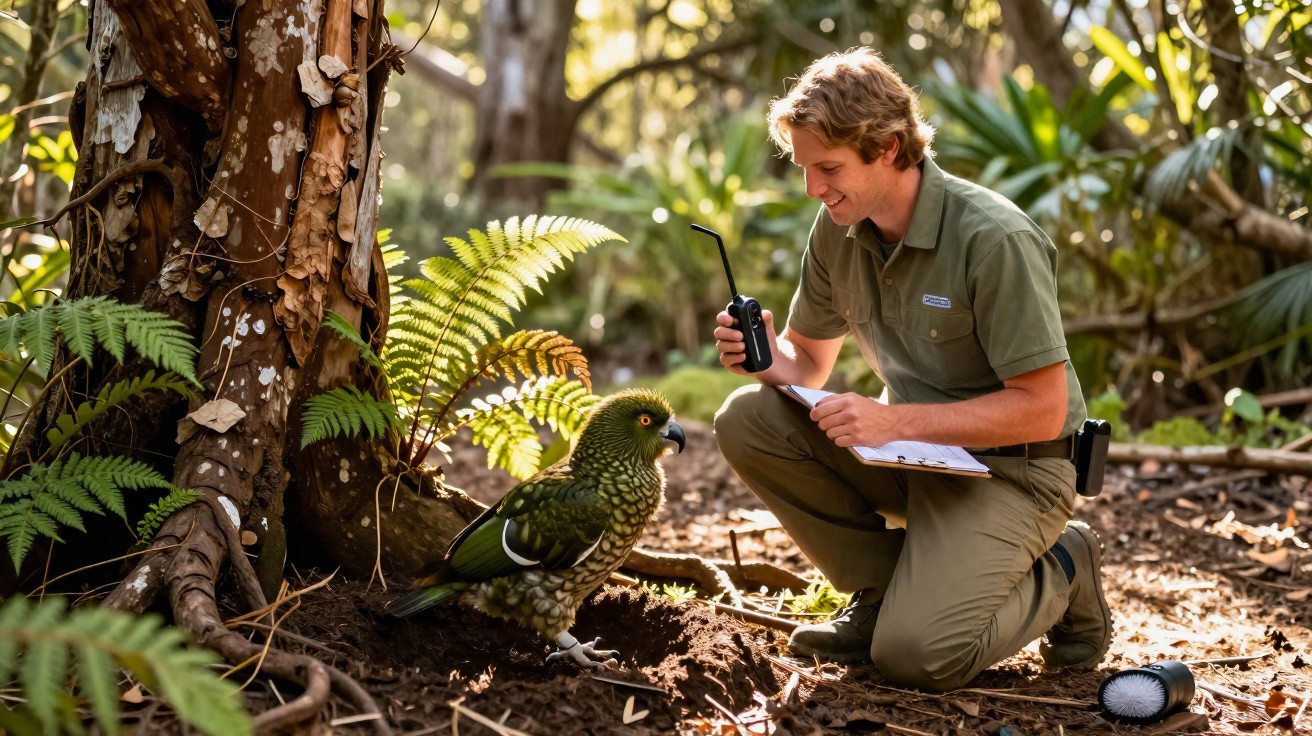
Um papagaio discreto se afasta do abismo
As equipes de conservação estão vendo nos dados um tipo de sinal que não aparece todo ano - e, quando aparece, costuma mudar o rumo de uma espécie. Para um papagaio famoso por ser fora do padrão e que já esteve à beira do desaparecimento, esses registros indicam que a Nova Zelândia pode estar entrando em uma rara temporada de reprodução intensa em 2026.
O kākāpō é o tipo de ave que não “ajuda” a própria recuperação: ele não voa, é ativo à noite e só se reproduz quando o ambiente está perfeito. Ainda assim, os colares de monitoramento voltaram a registrar a agitação e os comportamentos de corte que, para os pesquisadores, são o indício mais claro em anos de que uma temporada completa de reprodução está se formando.
The kākāpō, a flightless, night‑active parrot with moss‑green feathers and an owlish face, was once written off as a lost cause. By the mid‑1990s, just 51 birds were known to survive in the wild. Every individual was counted, named and monitored.
Three decades later, that tiny remnant has grown into a still‑fragile but far healthier population. At the start of 2026, New Zealand’s Department of Conservation reported 236 living kākāpō, including 83 females old enough to breed. For a species that sometimes manages only a handful of chicks in an entire year, those numbers look almost miraculous.
For the first time since 2022, monitoring collars are recording the frantic movement and courtship behaviour that signal a full breeding season.
The current season is already being described by field staff as “historic” because it may set a new record for chick numbers since detailed monitoring began about 30 years ago. Yet the stakes go beyond simple headcounts.
Como uma árvore ancestral controla um resgate moderno
Unlike many birds that nest annually, the kākāpō breeds only when conditions line up just right. Its entire life strategy is tied to one tree: the rimu, a native conifer that can live for more than 600 years.
Rimu trees occasionally produce huge crops of bright red fruit in an event known as “masting”. These bonanzas come at irregular intervals, often years apart, and nobody can predict them with certainty. When they do occur, kākāpō respond quickly.
Only when rimu trees fruit heavily do female kākāpō gain enough energy to form eggs, triggering a short, frantic reproductive window.
The last big rimu mast took place in 2022. That event powered the previous breeding season. Then came two quiet years with almost no nesting at all. Early 2026 has brought another strong rimu fruiting, and with it a wave of activity from the parrots.
Por dentro da bizarra vida amorosa do kākāpō
Most parrots form pairs and nest in tree cavities. The kākāpō takes a different route entirely. During breeding years, males gather in special display arenas called “leks”. Each male digs a shallow bowl in the ground, sometimes linked by small tracks, and clears vegetation around it.
After dark, they settle into these bowls and start to “boom”: a low, vibrating call that carries for kilometres through the forest. The bowls act like natural amplifiers, turning each male into a living subwoofer. Females, listening from far away hillsides, walk long distances toward the most impressive performers.
- Males stay at the lek, booming for weeks
- Females visit briefly, choose a mate and leave
- All chick‑rearing is done by the female alone
Once mating is over, the male never meets his chicks. The female lays her eggs, often in a hollow under tree roots, and raises the young without further help. In many nests only one chick survives, which slows population recovery even during a “good” year.
Conservacionistas repensam táticas de resgate com muita intervenção
To bring the species back from the edge, teams in New Zealand embraced an extremely intensive style of conservation. Rangers climbed into nests at night, removed eggs for artificial incubation and hand‑raised chicks in temperature‑controlled rooms. For years, every bird carried a radio or GPS tag, and some had health checks more frequently than many humans.
This obsessive care worked in the simplest sense: numbers climbed steadily. Yet side effects emerged. Some birds imprinted on people instead of their own species, struggled with normal social behaviour, or showed no fear of humans at all.
The best‑known case is Sirocco, a male kākāpō that became internet‑famous for attempting to mate with people and television presenters.
Biologists now worry that over‑managing nests might create generations of parrots that cannot cope without human help. That concern has shaped a new philosophy for the 2026 breeding season.
Uma mudança para aves mais selvagens e independentes
This year, teams are taking a conscious step back. Many eggs are being left in their nests rather than moved to artificial incubators. Mothers with more than one chick are given longer to manage on their own before staff consider stepping in.
The goal has subtly changed. Instead of trying to squeeze out every possible extra chick, managers want young birds to grow up in a more natural social setting, learning normal behaviours from their mothers and neighbours.
Success is no longer measured only in chick counts, but in how many parrots can live like wild kākāpō rather than lab projects.
Over the longer term, conservation leaders hope to restore kākāpō to parts of their former range on New Zealand’s main islands. That ambition depends on large predator‑free zones, since introduced species such as stoats, rats and cats quickly kill ground‑dwelling birds.
O que “livre de predadores” realmente significa
New Zealand has launched a national Predator Free 2050 programme, aiming to remove key invasive mammals. For a bird like the kākāpō, this could open new habitat, but only if the areas stay free of predators for decades.
That kind of security calls for layered strategies:
- Physical barriers, such as fences and offshore islands
- High‑tech trapping and remote cameras
- Community surveillance to detect new arrivals
- Long‑term funding for constant monitoring
Even a single pregnant rat can undo years of patient restoration on an island sanctuary. That risk keeps rangers on permanent alert.
Lendo a floresta como um barômetro do clima
The 2026 breeding season is not just a story about one species. Kākāpō reproduction also acts as a crude indicator of broader ecosystem health. Rimu masts depend on temperature and rainfall patterns, which are being nudged by climate change.
If future masts become less frequent or fall out of sync with kākāpō biology, entire generations could miss their chance to breed.
Some researchers are already modelling how shifting climate patterns might change fruiting cycles. In one scenario, rimu trees could mast more often but with smaller crops, providing less energy per event. In another, masts might cluster together and be followed by long sterile periods. Both situations would force conservation planners to rethink how they support female birds during lean years, perhaps by supplementary feeding or even planting new rimu stands in cooler, more suitable zones.
Por que esse raro papagaio fascina pessoas muito além da Nova Zelândia
For many outside New Zealand, the kākāpō first came to attention through viral videos and quirky documentaries. A rotund, flightless parrot that booms like a drum and climbs trees with its beak is hard to forget. Yet behind the charm lies a deeper lesson about how slowly some species recover once pushed to the edge.
The kākāpō shows what it takes to rebuild a population when every breeding attempt is precious: decades of funding, deep collaboration with Indigenous communities such as Ngāi Tahu, and a willingness to adjust tactics when unintended consequences appear. It also shows how closely wildlife survival can depend on ancient rhythms, like the fruiting cycle of a conifer that began growing centuries before any of today’s scientists were born.
For readers watching from afar, the 2026 breeding season offers a real‑time case study in modern conservation. Success will not be clear for months, until eggs hatch and chicks make it through their vulnerable first weeks. Even then, one good year is not enough. Kākāpō typically live for decades, so the true test lies in whether today’s chicks become tomorrow’s confident, independent adults, booming from their own leks on quiet New Zealand hillsides.





Comentários
Ainda não há comentários. Seja o primeiro!
Deixar um comentário